
"Human Vapor": Netflix and Toho's Anti-Authoritarian Reboot of a Classic Japanese Film
Netflix's first co-production with Toho turns 1960's "The Human Vapor" into an eight-episode thriller. Yeon Sang-ho and Shinzo Katayama blend the tokusatsu legacy with body horror and political rage.
 IMDb6.6/10
The opening scene of 'Human Vapor' immediately makes clear where the show is headed. As journalist Kyoko Kono (Yû Aoi) interviews a scientist working on biomass energy live on air, a strange vapor seeps into the studio on its own. The vapor slips under the scientist's clothes, then into his airways; it lifts him into the air and finally makes him explode. Shot with pulsating CG effects, this overt body-horror scene announces that the reboot won't be bound by the restrained kaiju cinema of the 1960s.
This is the first collaboration between Netflix and the venerable Japanese studio Toho, carrying the joint signature of Korean showrunner Yeon Sang-ho and Japanese director Shinzo Katayama. The original film came from 'Godzilla' director Ishirō Honda and effects pioneer Eiji Tsuburaya.
What was the original "The Human Vapor" about?
The film was a tokusatsu production — a word that literally means "special filming," describing the Japanese film-and-TV tradition built on practical effects: costumed creatures, miniature cities, masked heroes, giant mechs. Tsuburaya is sometimes called "the father of tokusatsu"; he also created the original 'Ultraman' series.
'The Human Vapor' belongs to Toho's "Transforming Human Series" trilogy: three films about people altered by scientific intervention who steal and kill with their new powers, setting their own moral code and evading the law. In the film, Mizuno (Yoshio Tsuchiya) is a librarian who left the air force for health reasons; when the experiment he undergoes goes wrong, he turns into a being capable of becoming gaseous, and takes to robbing banks to fund the stage comeback of Fujichiyo, the dancer he loves.
What made the film special?
Honda and Tsuburaya delay the first transformation, but in the second half they use dry ice, optical compositing, and wire work in the same scene to make the effect convincing. What's most striking about the film is the political undercurrent it quietly carries: the atomic age that gives Mizuno his power also gives him a new morality. "I am no longer human," he says. "Therefore I am no longer bound by human law."
How close is the show to the original?
There's no bank robbery in the series; the eight-episode story is entirely original and shifts its focus to the world of idols and the yakuza. Still, there are nods to Honda's film: the leads share names with Detective Kenji Okamoto (Shun Ogori) and Kyoko Kono, but they're no longer lovers — Kyoko's ill-timed interview with a suspect torpedoed Kenji's investigation, and Kenji was suspended.
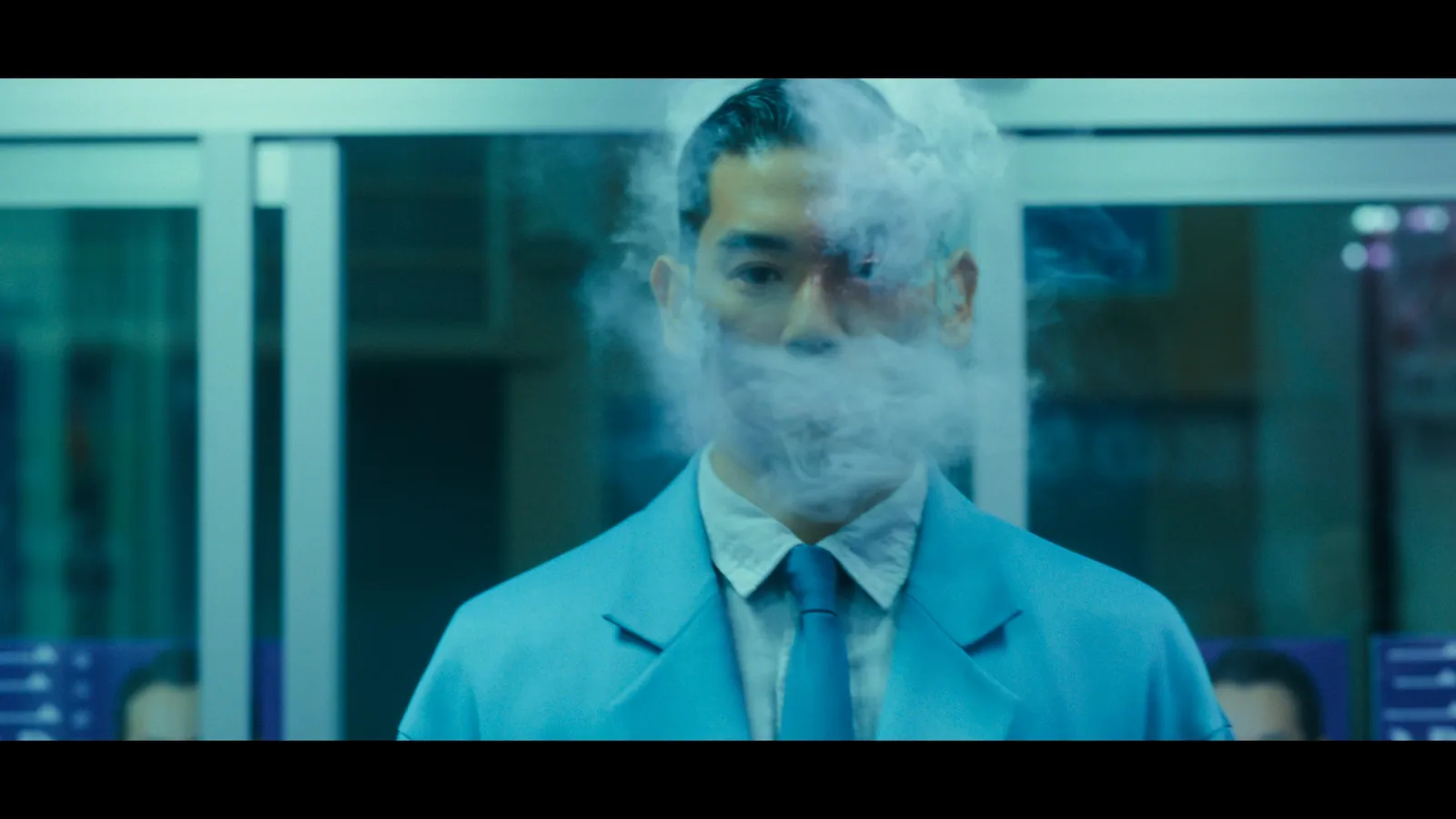
The biggest difference is that the mission of Human Vapor (model UTA) is now explicitly political. In his oversized blue suit and with a flat voice, he wants everyone who has touched "White Center" to answer for their historical crimes, setting off a conspiracy that links politicians, corporate executives, and corrupt police. The original Mizuno was talkative and rational; the show's version is almost in a hypnotic trance, speaking little, his gaze empty and menacing.
Amplifying social critique
The show stays closest in spirit to the original Toho film through its themes. As Katayama told Netflix, the goal was "to accurately portray dynamics like the relationship between the powerful and the powerless in contemporary Japanese society." Yeon Sang-ho and co-writer Takeshi Kimura leave no corner of the world untouched by corruption: Kenji's first scene opens with him intervening at a restaurant owner exploiting a migrant worker; Kyoko meets an ostracized alcoholic journalist for persistently reporting on White Center; a senile former White Center executive spends his final years in a coastal commune, weighed down by guilt.
In the end, 'Human Vapor' makes smart adaptation choices: it doesn't just amplify the spectacle of its effects, it also foregrounds the film's subtextual rebellion against authority, pushing the action, through tragic character relationships, into territory the tokusatsu creatures of the original could never have reached.